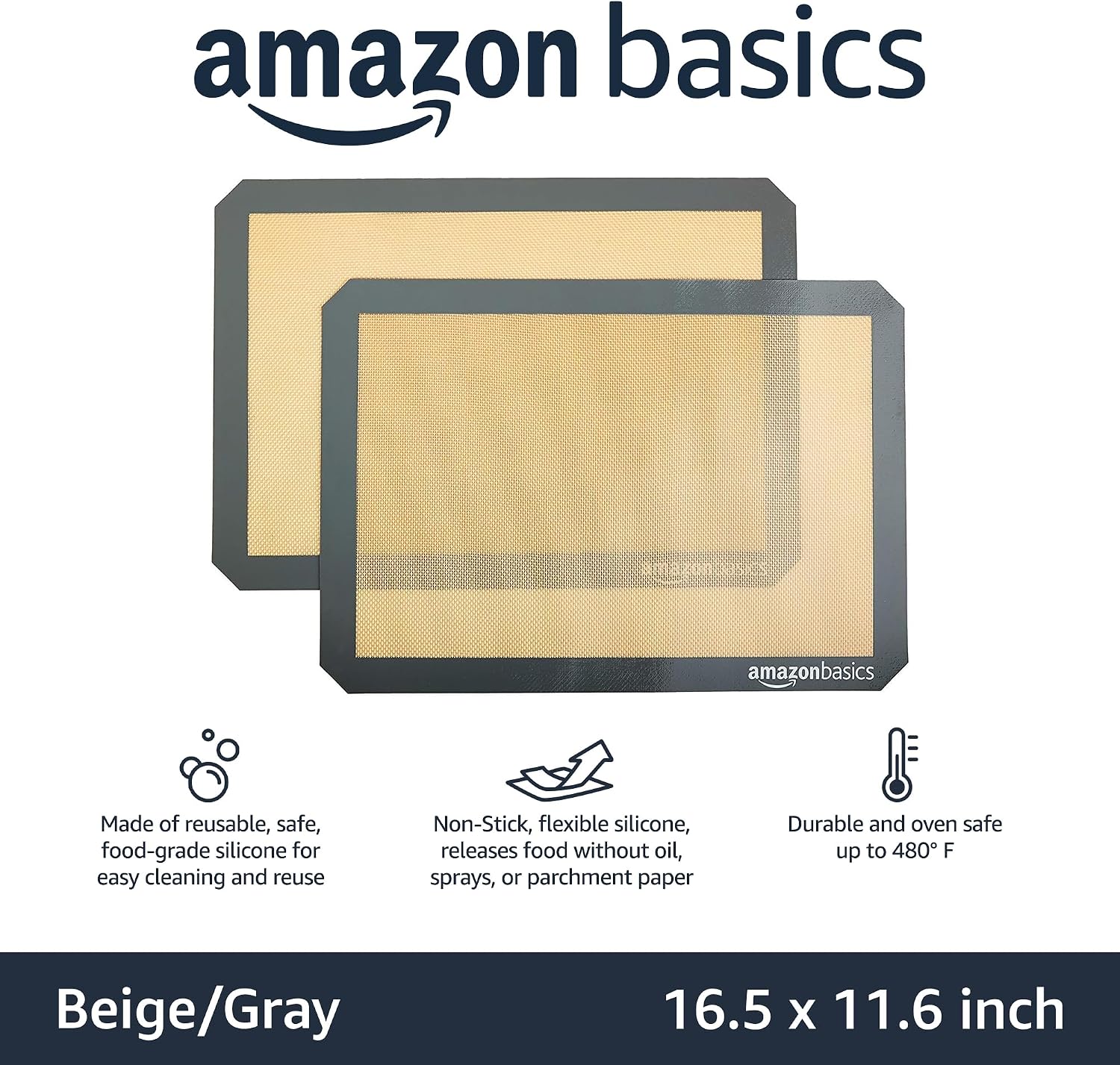
If you’ve never thought twice about what goes under your kid’s cookie dough, you’re not alone. A silicone baking mat is exactly what it sounds like: a flat, flexible sheet made from food-grade silicone (a heat-safe, rubbery material used in thousands of kitchen products) that you lay on top of a regular baking sheet before adding your food. Instead of greasing a pan or tearing off parchment paper every single time, your kid just places the mat down and starts cooking. When baking is done, the mat peels clean, goes in the dishwasher, and is ready for next weekend. That’s the whole idea — and it turns out that simple swap matters a lot when little hands are in the kitchen. This guide will walk you through why these mats are worth owning, what the tradeoffs actually are, and how to pick the right one for where your family is right now.
| EDITOR'S PICK[Amazon Basics Silicone Rectangu…](https://www.amazon.com/dp/B0725GYNG6?tag=greenflower20-20) | Mid-tierNon-slip Silicone Pastry Mat Ex… | Budget pickSilicone Pastry Baking Mat Doug… | |
|---|---|---|---|
| Dimensions | 16.5" x 11.6" | 28" x 20" | 16" x 24" |
| Suitability | Baking, reusable | Rolling, baking | Rolling, baking |
| Dishwasher Safe | ✓ | — | — |
| Non-Slip | — | ✓ | ✓ |
| Price | $15.99 | $9.99 | $7.99 |
| See on Amazon → | See on Amazon → | See on Amazon → |
Why a Silicone Mat Specifically Helps Young Bakers
Here’s the honest case for this tool, because “it’s nonstick” doesn’t quite capture it.
Cookies don’t stick and don’t burn on the bottom. Owners of silicone mats consistently report that the insulating layer between the pan and the dough produces more even browning — particularly on the underside of cookies, where direct metal-to-heat contact causes the scorching that frustrates new bakers. The Spruce Eats’ silicone baking mat buying guide specifically flags this as the reason home bakers prefer mats over bare pans for cookies and pastry work.
Kids can do more of the work independently. When your eight-year-old doesn’t have to worry about buttering a pan or tearing off the right length of parchment without ripping it, they can focus on the actual cooking skill — measuring, mixing, shaping. Fewer setup steps = more confidence, fewer meltdowns, faster wins.
Cleanup becomes a two-second job. Parents.com’s kitchen safety guides consistently emphasize that reducing friction in the cleanup phase is one of the biggest factors in whether kids stay interested in cooking long-term. A mat that wipes or rinses clean in seconds removes the “ugh, who’s going to clean this” negotiation entirely.
No waste. Parchment paper is genuinely useful, but if your family bakes even twice a month, those rolls add up — financially and in terms of trash. A quality silicone mat, used gently, is rated for several hundred baking cycles by most manufacturers. The cost-per-use math is straightforward: a $12 mat used 200 times costs you six cents per session.
The Real Tradeoffs (Because There Are Some)
No tool is perfect, and framing silicone mats as a magical fix would do you a disservice. Here’s where families run into friction.
They’re not right for every recipe. America’s Test Kitchen’s equipment corner notes that silicone mats actually slow browning because of that insulating effect — which is great for delicate cookies, but a problem if you’re roasting vegetables or making something that needs a crispy, caramelized bottom. For high-heat roasting above 450°F, a bare pan or parchment is often better. If your kid is baking cookies and doing sheet-pan dinners, you may want both options in the drawer.
Size has to match your pans. Most standard silicone mats are sized for a half-sheet pan (roughly 13 × 18 inches). If you’re working with smaller toaster-oven pans or quarter-sheet pans (which are common in kids’ starter kits), a standard mat won’t fit and you’ll end up with folded edges — a safety and baking-quality problem. Measure your pans first.
Cheaper mats can have odor issues. Good Housekeeping’s silicone baking mat roundup specifically flags that lower-quality mats — especially those without an FDA food-grade silicone certification — can release a faint rubber or chemical smell during the first few uses, and sometimes persistently. This is more of an annoyance than a health risk at normal baking temperatures, but it’s worth paying a few extra dollars to avoid.
They absorb strong flavors. Garlic, fish, and strongly spiced dishes can linger in silicone even after dishwashing. Families who bake desserts and also cook savory sheet-pan meals sometimes keep two mats — one dedicated to sweet, one for savory.
By the Numbers
| Factor | Silicone Mat | Parchment Paper |
|---|---|---|
| Upfront cost | $10–$20 (one-time) | $5–$8 per roll (recurring) |
| Uses per item | 200–2,000+ (manufacturer-rated) | 1 per sheet |
| Dishwasher safe | Yes (most) | No |
| Best for | Cookies, pastry, bread | Roasting, high-heat, liners |
| Heat rating (typical) | Up to 480°F | Up to 425°F |
What to Actually Look for When Buying
You don’t need to spend $30+ to get a good mat. But you do need to look at a few things before clicking “add to cart.”
FDA food-grade silicone. This is the non-negotiable. Consumer Reports’ overview of bakeware safety and nonstick materials confirms that food-grade silicone — the kind that has passed FDA safety review for direct food contact — is considered safe at normal baking temperatures. Look for it called out explicitly in the product description. If a listing doesn’t mention it, that’s a red flag.
Fiberglass mesh reinforcement. Better mats have a woven fiberglass core inside the silicone, which keeps the mat flat, extends its life, and improves heat distribution. This is what separates the workhorses from the floppy dollar-store versions. You’ll see it described as “PTFE-coated fiberglass” or simply “fiberglass core” in listings.
Correct sizing for your setup. As noted above: measure your baking sheet before you buy. Half-sheet (13 × 18 in.) is the most common adult size. Quarter-sheet (9 × 13 in.) fits better in toaster ovens and smaller starter-kit pans. Some brands sell sets that include both.
Dishwasher-safe confirmation. Most quality mats are top-rack dishwasher safe, but some manufacturers still recommend hand washing to extend the mat’s life. If easy cleanup is a priority — and it probably is, since we’re talking about kids — confirm dishwasher compatibility before buying.
Rolled or flat storage. Silicone mats can’t be folded (creasing damages the fiberglass core), so they need to be stored flat or loosely rolled. Think about where yours will live before you buy. Some families hang them on a baking sheet rack; others roll them and store them in a tube or drawer organizer.
Which Mats Families Actually Recommend
A few names come up repeatedly across reviews and parent communities when people talk about mats that hold up to consistent kid-kitchen use.
Silpat is the name reviewers return to most often for quality and longevity. It’s a French brand, widely credited with popularizing the silicone baking mat category for home kitchens, and it’s the one America’s Test Kitchen has consistently held up as the reference point for silicone mat performance. Owners report that Silpat mats stay flat, don’t absorb odors as readily as cheaper options, and survive years of regular use. They’re priced at roughly $25–$35 for a half-sheet size — higher than the budget field, but reviewers consistently say the lifespan justifies it.
Kitzini and AmazonBasics-adjacent options in the $10–$15 range are what most families start with, and across aggregated reviews the pattern is: they work well for cookies and standard baking, they have a slightly shorter lifespan than Silpat, and a small percentage of buyers note the initial odor issue mentioned above. For a first mat — especially if you’re not sure your kid will stick with baking — starting here is completely reasonable.
Nordic Ware offers silicone baking accessories that pair naturally with their sheet pans, and if you’re already building out a Nordic Ware bakeware set (a common starting point for families investing in a proper kids’ kitchen), matching their mat to their pans is a sensible move. Reviewers appreciate the consistent sizing across the product line.
For a gift context — say, you’re putting together a baking starter kit for a birthday — pairing a quality silicone mat with a quarter-sheet pan, a small silicone spatula, and a kids’ cookbook makes a genuinely useful and thoughtful bundle in the $40–$60 range. It’s one of those gifts that actually gets used.
The Decision Rule
If you’re sorting out whether this is the right moment to add a silicone mat to your kid’s kitchen setup, here’s the honest if/then:
If your kid is baking cookies, brownies, or bread more than once a month — yes, buy one now. The quality of results improves, cleanup is faster, and the cost-per-use drops to nearly nothing after the first few sessions. Start with a budget option if you’re not sure; upgrade to Silpat if it becomes a fixture.
If your kid mostly does high-heat roasting or is still in the “occasional Saturday experiment” phase — parchment paper is fine for now. No need to add gear before the habit is established.
If you’re buying this as a gift — pair it with same-size pans so the recipient doesn’t end up with a mat that doesn’t fit. A half-sheet mat + half-sheet Nordic Ware pan is a reliable combination that fits most home ovens. Confirm the recipient’s oven situation before going smaller.
If you’re building out a full kids’ baking kit — buy two mats: one half-sheet for the oven, one quarter-sheet for the toaster oven. That covers virtually every baking scenario a junior chef will hit in the next several years, and the total investment is under $30.
The bottom line is that a silicone baking mat is one of the few kitchen tools that genuinely earns its drawer space from the very first use. It doesn’t require skill to deploy, it reduces one of the biggest friction points in cooking with kids (the mess), and it costs less than a single batch of specialty cookie ingredients. Here’s what other families have found: once it’s in the kitchen, it rarely comes out of rotation.