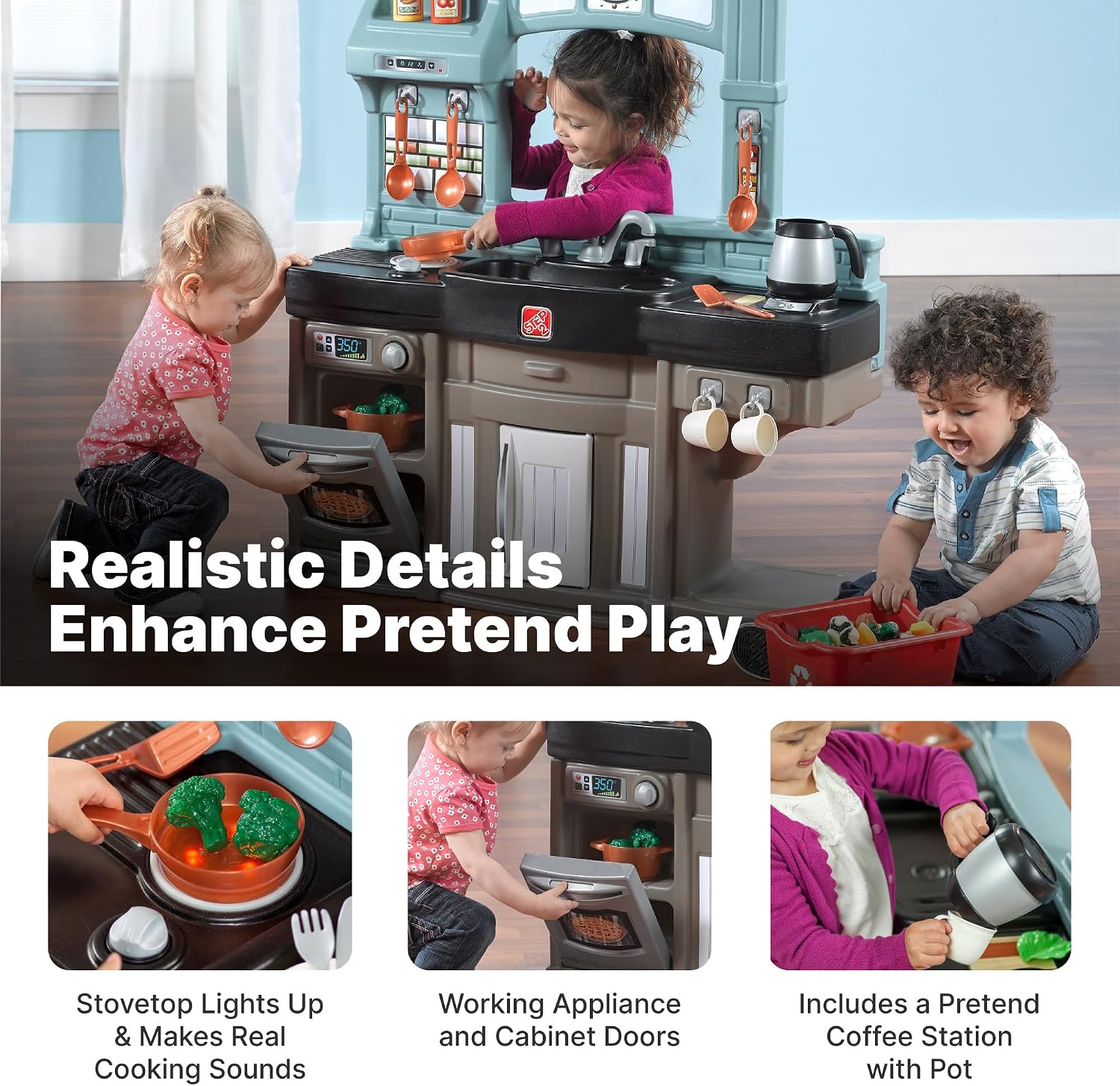
If you’ve ever watched a two-year-old “stir” a pot of imaginary soup with absolute seriousness, you already understand why pretend play kitchen sets matter. A play kitchen — essentially a child-sized, toy version of a real kitchen, complete with a stovetop, sink, and sometimes an oven — gives toddlers a safe, low-stakes place to rehearse the rhythms of cooking long before they’re anywhere near a hot burner. Child development researchers call this “symbolic play,” and the American Academy of Pediatrics’ 2018 clinical report on the power of play links it directly to the development of language, problem-solving, and emotional regulation. In plain terms: when your three-year-old pretend-cooks dinner, they’re actually practicing the skills that make real cooking feel natural later. This guide will help you find the right pretend kitchen for your child’s age and your family’s space, with honest tradeoffs on price, materials, and longevity — so you spend money once and buy something your kid actually grows with.
Why the Play Kitchen Phase Actually Matters for Future Cooks
It’s tempting to treat a play kitchen as a glorified distraction device, but the research and the parenting community consistently point to something more meaningful going on.
The American Academy of Pediatrics report cited above notes that play — specifically child-directed, imaginative play — is one of the primary mechanisms through which young children build executive function. In the kitchen context, that means sequencing (“first I chop, then I stir”), cause and effect (“the ‘food’ goes in the pot before it’s ready”), and narrative thinking (“I’m making dinner for the whole family”). Parents.com’s 2025 buying guide on play kitchens echoes this, noting that the best kitchen sets extend play sessions precisely because they offer open-ended, story-driven experiences rather than single-outcome toys.
For families who eventually want their kids at the cutting board or measuring ingredients by age six or seven, this phase is the on-ramp. The toddler who’s been “cooking” for two years has already internalized concepts like sequence, tool purpose, and the social ritual of sharing food. When real cooking begins — with a real child-safe knife or a real mixing bowl — it doesn’t feel foreign. That’s the payoff.
The parenting tradeoff is real, though. Play kitchens take up floor space. The cheaper ones shed plastic parts within a season. The premium ones photograph beautifully but can feel excessive for a child who’ll outgrow them by kindergarten. All of that is worth naming up front, because the right choice genuinely depends on your situation.
What to Look For: The Decision Frame
Before you look at specific sets, here are the four variables that should drive your decision. Think of it as a 2x2 you run in your head before clicking “add to cart.”
1. Age Range and Actual Play Duration
Most play kitchens are designed for ages 2–6, but that range hides meaningful variation. A 18-month-old needs large, chunky accessories with no small parts. A four-year-old can handle more realistic-looking accessories and benefits from a set with more features — a working (battery-operated) light inside the oven, a clicking burner dial — because those details sustain longer, more complex imaginative play.
Good Housekeeping’s 2025 roundup of toy kitchens notes a consistent pattern in aggregated reviewer feedback: parents of kids under two are happiest with simple, durable sets that prioritize safety. Parents of kids aged three to five consistently rate “realistic details” as the feature that extends daily play the longest.
If X, then Y: If your child is under two, prioritize durability and large-part safety over features. If they’re three-plus, invest in detail — it pays back in months of play.
2. Materials: Wood vs. Plastic vs. Hybrid
This is the debate in every parent forum, so here’s the honest breakdown.
| Material | Strengths | Weaknesses |
|---|---|---|
| Solid wood | Aesthetic, durable, often heirloom-quality | Higher price ($80–$250+), heavier, less likely to have interactive features |
| MDF/painted wood | Mid-range price, looks great in photos | Can chip or swell if wet; watch for low-VOC paint labeling |
| Plastic | Lightweight, interactive features (lights, sounds), easy to wipe clean | Can feel cheap; lower-end versions shed parts; less photogenic |
| Hybrid (wood frame + plastic components) | Best of both in the premium mid-range | Accessories may not match aesthetically |
Apartment Therapy’s 2024 guide to play kitchens that “look good in your home too” makes the practical point that wood sets from brands like KidKraft or Pottery Barn Kids tend to integrate into living spaces without becoming an eyesore — a real consideration if your apartment or home is small and the kitchen will live in a visible room.
If X, then Y: If aesthetics and longevity matter and you have $120–$200 to spend, wood or hybrid is worth it. If you need something under $60 that a toddler can bang around, a well-reviewed plastic set from a name brand is the honest call.
3. Accessories: Quality Over Quantity
Here’s where families consistently overspend or get burned. A set that comes with 50 plastic food pieces sounds like value — until half of them are under the couch by week two. Reviewers across multiple platforms (per Good Housekeeping’s aggregated feedback summary) note that smaller accessory sets with more realistic, weighted, or better-designed pieces sustain play longer than large sets of flimsy items.
Look for:
- Accessories sized appropriately for your child’s hands
- Food pieces with some tactile distinction (soft, wooden, or fabric-covered)
- A limited, curated set rather than the highest piece count
If you’re buying accessories separately to augment a basic kitchen frame, that’s often the smarter move — you can add a wooden cutting set or a realistic-looking dish set incrementally.
4. Footprint and Storage
Consumer Reports’ general toy safety and selection overview notes that large, stationary toy furniture should be stable enough that it won’t tip if a toddler pulls on it — a genuine safety consideration, not just a design preference. Check that play kitchens have a wide enough base or come with wall-anchor hardware for families in earthquake zones or with very active kids.
Beyond safety: measure your space before you buy. A two-sided “island” kitchen looks stunning in a showroom and takes up as much floor space as a real kitchen island. If you’re in an apartment or a shared bedroom situation, a compact single-unit kitchen (typically 24–30 inches wide) is more realistic.
By the Numbers
| Price tier | What you typically get | Expected play lifespan |
|---|---|---|
| Under $50 | Plastic, basic features, large accessory set | 1–2 years; fine for very young toddlers |
| $60–$120 | Hybrid or MDF wood, moderate accessories, some interactive features | 2–4 years |
| $120–$250+ | Solid or painted wood, curated accessories, design-forward | 3–5+ years; resale value is meaningful |
Melissa & Doug’s deluxe wooden kitchen sets sit in that $120–$200 range and consistently appear at the top of aggregated reviewer lists, including Parents.com’s 2025 guide, for combining durability with design. KidKraft occupies the $80–$150 hybrid sweet spot and owners frequently note that sets survive two or more children in the same household.
Our Picks by Situation
These recommendations are grounded in what owners report and what editorial sources consistently rate — not hands-on testing. Think of these as the patterns that emerge when you read a few hundred reviews so you don’t have to.
Best for very young toddlers (18 months–2.5 years): Look for a simple, solid-plastic or solid-wood set with no small parts, rounded edges, and a handful of large accessories. The Melissa & Doug Let’s Play House! Dust, Sweep & Mop Set paired with a basic kitchen frame is a combination families keep coming back to for this age group.
[PRODUCT: Melissa & Doug Let’s Play House Kitchen — TIER:mid-range]
Best mid-range pick for ages 3–5: KidKraft’s uptown espresso kitchen and similar hybrid sets in the $100–$150 range show up consistently as the “I’d buy this again” pick in long-run reviews. Owners report that the realistic detail — the clicking knobs, the opening oven door — is what keeps kids coming back past the first week.
[PRODUCT: KidKraft Uptown Espresso Play Kitchen — TIER:mid-range]
Best premium pick / gift option: If you’re a grandparent or gift-giver looking for something that photographs beautifully, has meaningful staying power, and will be remembered — Pottery Barn Kids and Williams Sonoma Kids both carry solid-wood kitchen sets in the $180–$250 range that reviewers describe as heirloom-quality. These are the sets that get passed to younger siblings.
[PRODUCT: Pottery Barn Kids Retro Kitchen Set — TIER:premium]
Best budget-conscious starter: Under $60, look for name-brand plastic sets from Step2 or Little Tikes. Both brands have long track records in the toddler toy space, and Consumer Reports consistently cites established toy brands as more reliable on safety testing documentation than unbranded imports.
[PRODUCT: Step2 Lifestyle Kitchen Playset — TIER:budget]
The Decision Rule: If X, Then Y
Here’s the simplified framework for parents still on the fence:
- If your child is under 2: Keep it simple and safe. Spend under $60. The complexity of a premium set is wasted at this age.
- If your child is 3–5 and plays imaginatively for 20+ minutes at a stretch: This is the sweet spot for a $100–$150 hybrid or wood set. The investment pays back in months of daily engagement.
- If you’re buying as a gift for a household you don’t know well: A curated set from a premium brand (Melissa & Doug, Pottery Barn Kids) in the $120+ range is a safe, crowd-pleasing choice that parents consistently appreciate.
- If space is genuinely tight: Prioritize footprint over features. A compact, well-made single-unit set beats a sprawling “dream kitchen” that takes over the room and breeds resentment.
- If longevity and resale value matter: Wood wins. Full stop. A well-maintained wooden kitchen set from a reputable brand holds resale value well, and some families recoup 40–60% of purchase price when their child ages out.
The goal here isn’t the fanciest kitchen. It’s the one your kid actually uses, every day, until they’re ready to graduate to the real thing — and then stands at the counter next to you like they’ve been doing it their whole life. Because, in a way, they have.