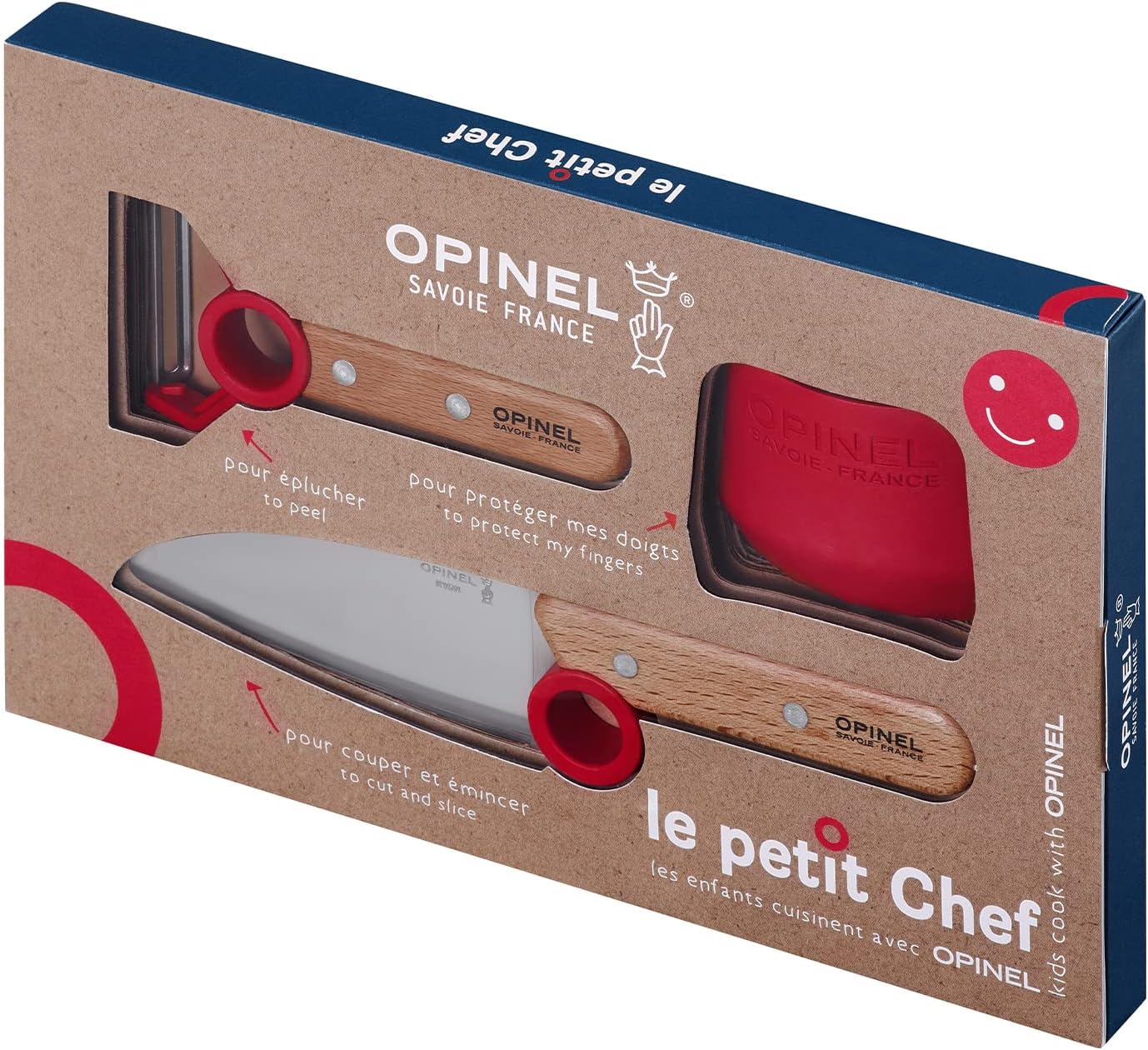
If your child has started asking to actually help in the kitchen — not just stir, but really cook — you’ve probably already started wondering whether kids’ tools are worth the investment or just expensive toys. The Opinel Le Petit Chef set is a French-made knife kit designed specifically for children learning to cook with real equipment. “Real equipment” is the key phrase: these are actual knives with actual blades, not the rounded plastic tools that come with a toy kitchen. The set typically includes a child-sized peeler, a fork, and a small knife with a finger-guard system designed to protect little hands while still letting kids make genuine cuts. It retails in the $60–$80 range depending on retailer and configuration. This article pulls together what parents and reviewers have consistently said after living with this set — so you can decide whether it’s the right call for your family before you buy.
| EDITOR'S PICK[Opinel Le Petit Chef Complete 3…](https://www.amazon.com/dp/B0BYD32RF5?tag=greenflower20-20) | Mid-tier[TruChef 5-Piece Kids Knife Set…](https://www.amazon.com/dp/B06XBJ189G?tag=greenflower20-20) | Budget pickZWILLING TWINNY Kids Chef’s Kni… | |
|---|---|---|---|
| Material | — | Stainless Steel | — |
| Knife Length | — | — | 4.5" |
| Set Pieces | 3 | 5 | 1 |
| Finger Guard | ✓ | — | — |
| Peeler Included | ✓ | ✓ | — |
| Price | $59.00 | $35.99 | $29.95 |
| See on Amazon → | See on Amazon → | See on Amazon → |
What’s Actually in the Box (and What the Price Buys You)
Let’s start with the basics, because “Le Petit Chef” shows up in a few different configurations and it’s easy to get confused.
The most commonly purchased version — the one reviewed across Good Housekeeping’s best kids cooking tools roundup and The Spruce Eats’ buyer’s guide — is the three-piece set: a rounded-tip knife, a peeler, and a fork, all with brightly colored handles (typically available in blue, red, or yellow). Some retailers bundle in a finger guard and a cutting board; others sell those separately. If you’re shopping at Williams Sonoma Kids or Sur La Table, the bundled version with the board is usually the better value.
The handles are sized for children roughly ages 6 and up, though most parent reviewers note the sweet spot is ages 7–12. The knife features what Opinel calls a “round tip” design (a blade with a blunted point rather than a sharp tip) and a finger-protect ring — a small plastic collar that sits near the blade to stop fingers from sliding forward onto the edge. That’s the central design innovation, and it’s the thing parents either love immediately or take a few sessions to get comfortable with.
By the numbers:
- Retail price range: $60–$80 for the three-piece set (2026 pricing)
- Recommended age: 6–12 (most confident fit: 7–10)
- Country of manufacture: France
- Blade material: Stainless steel
What Parents Actually Say After Months of Use
Here’s where an honest review earns its keep. Across aggregated parent reviews cited by Good Housekeeping, The Spruce Eats, and Wirecutter’s gift roundups, the feedback clusters into a few consistent themes. These aren’t cherry-picked quotes — they’re the patterns that repeat.
The finger guard divides families cleanly
This is the single most discussed feature, and it produces two distinct camps.
Camp One (roughly 60–70% of reviewers) says the finger guard is the whole point. Parents who were previously nervous about their child using any real blade report that the guard gave them — and their child — the confidence to actually practice. The child feels the knife, learns grip, builds muscle memory. The guard is doing its job quietly in the background. Reviewers at The Spruce Eats consistently note that this is the feature that separates Le Petit Chef from cheaper kids’ knife sets where the “safety” comes entirely from a dull blade.
Camp Two says the guard gets in the way. This group tends to be parents of older children (10+) or kids who have already been cooking with adult supervision for a couple of years. Their feedback: the guard changes the grip angle enough that it can teach a slightly awkward hand position that has to be unlearned later. America’s Test Kitchen Kids’ curriculum notes on knife skills emphasize that proper grip — the “pinch grip,” where the thumb and forefinger pinch the blade just above the handle — is foundational, and a few parents report the finger collar makes that grip feel less natural.
The decision rule here is straightforward: If your child is 6–9 and new to real knives, the guard is a net positive. If your child is 10–14 and has already been using adult knives with close supervision, you may want to evaluate whether the guard helps or hinders based on what you observe in the first few sessions.
Sharpness is the right kind of surprise
New parents sometimes expect a “kids’ knife” to be dull by design. It isn’t, and that catches some families off guard — in a good way. Owners consistently report that the blade holds a reasonable edge and actually cuts produce cleanly, which means children get genuine feedback from the tool: apply the right technique, and the carrot slices. This is meaningfully different from the experience of using a dull blade, where kids compensate with force and develop bad habits. Parents.com’s kitchen safety guide for kids specifically flags this: a sharp knife that cuts predictably is safer than a dull one that slips.
The tradeoff is that parents do need to treat this like a real knife from day one — stored safely, not tossed in a drawer with other utensils, and sharpened occasionally as any steel blade requires.
Durability over a year or more
The most useful long-run data point from aggregated reviews: the handles hold up. Unlike some kids’ cooking tools where the bright plastic cracks or the blade-to-handle connection loosens after a few months, parent reviewers who report back after 12–18 months consistently say the set still looks and performs close to new. The stainless blade resists staining. The plastic handles survive dishwasher cycles (top rack), though multiple reviewers note that hand-washing extends the life of the color finish. The Spruce Eats’ buyer’s guide flags hand-washing as the recommended care method for the full set.
One honest wear note: the finger guard, being separate plastic, is the piece most likely to develop minor play or wobble first. It’s not a structural failure — it’s cosmetic loosening — but worth knowing going in.
How Le Petit Chef Compares to the Alternatives
If you’re deciding between this set and other options at similar price points, the comparison-frame matters.
vs. A starter silicone kit ($15–$25): The silicone starter kits — the kind that include a wavy-edge “kids’ knife” in colorful plastic — are appropriate for ages 4–6 who are at the “help Mommy in the kitchen” stage. They’re not the same category. If your child is 7+ and genuinely curious about cooking, the silicone kit will frustrate them within a season. Le Petit Chef is the natural step up.
vs. A real adult paring knife ($20–$40) with close supervision: This is the real comparison for parents of older kids (10+). A quality paring knife with a parent right there is a legitimate option, and America’s Test Kitchen Kids’ curriculum notes that many professional chefs’ children learn on properly supervised adult tools. The Le Petit Chef set’s advantage is the purpose-built sizing, the visual cue to the child that this is their equipment, and the gift-ability — it photographs beautifully, it has a story, and it arrives in packaging that delights. Those aren’t nothing.
vs. The Victorinox Fibrox 6” chef’s knife (sometimes recommended as a starter for older kids): The Victorinox is a serious knife at a lower price point, but it’s adult-sized and has none of the child-specific design features. For an 8-year-old, Le Petit Chef wins on fit. For a 13-year-old serious junior chef, the Victorinox may be the better long-run investment. Wirecutter’s cooking-gifts feature has flagged this tradeoff in past coverage.
Is This the Right Buy for Your Family? The Decision Framework
Here’s the honest if/then read, because that’s what actually helps.
If your child is 6–9 and new to real cooking tools: Le Petit Chef is as close to a consensus pick as this category has. The finger guard, the sizing, the sharpness, and the durability all land in the right place for this age and experience level. Reviewers consistently return to it as a milestone gift. Buy it.
If your child is 10–12 and has some supervised cooking experience: Still a strong choice, but pay attention to the finger guard in the first few sessions. If it’s creating an awkward grip, the guard can be removed (it’s not permanently fixed), and some parents use it this way — finger guard for the first month, then removed as confidence builds. This flexibility is underreported and worth knowing.
If your child is 13+ and ready for real technique: The Le Petit Chef set may be more gift than tool at this point. Consider pairing a quality entry-level adult knife with a dedicated cookbook like those from America’s Test Kitchen Kids or Phaidon’s children’s food titles, and investing the savings in an ongoing cooking class. The gear should match the ambition.
If you’re buying as a gift (grandparent, aunt, uncle, family friend): This is one of the easiest gift recommendations in the kids’ kitchen space. It arrives in attractive packaging, it’s clearly purposeful rather than toyish, and it signals that the giver takes the child’s interest seriously. Pair it with a small cutting board and a kid-friendly cookbook for a bundle that photographs beautifully and genuinely gets used. Multiple gift guides — including those from Good Housekeeping and Wirecutter — have recommended this combination at the $80–$120 total bundle range.
A Few Things to Set Up Before It Arrives
Owners who report the best experiences with the Le Petit Chef set consistently mention one thing: they prepared before the set arrived, not after.
Specifically: decide where the knife lives (a knife block, a blade guard, a dedicated drawer slot — not loose in a utensil drawer), walk through one or two basic cuts together on the first session before letting your child work independently, and set a clear rule about the knife only coming out when an adult is present. Parents.com’s kitchen safety guidance recommends treating a child’s first real knife like any other safety milestone — car seat, bike helmet — in that the rules are set clearly before the first use, not discovered through an incident.
The Le Petit Chef set won’t replace supervision. But for families ready to actually cook together with real tools, it’s one of the most consistently well-regarded starting points in the category — and a year of parent reviews backs that up.