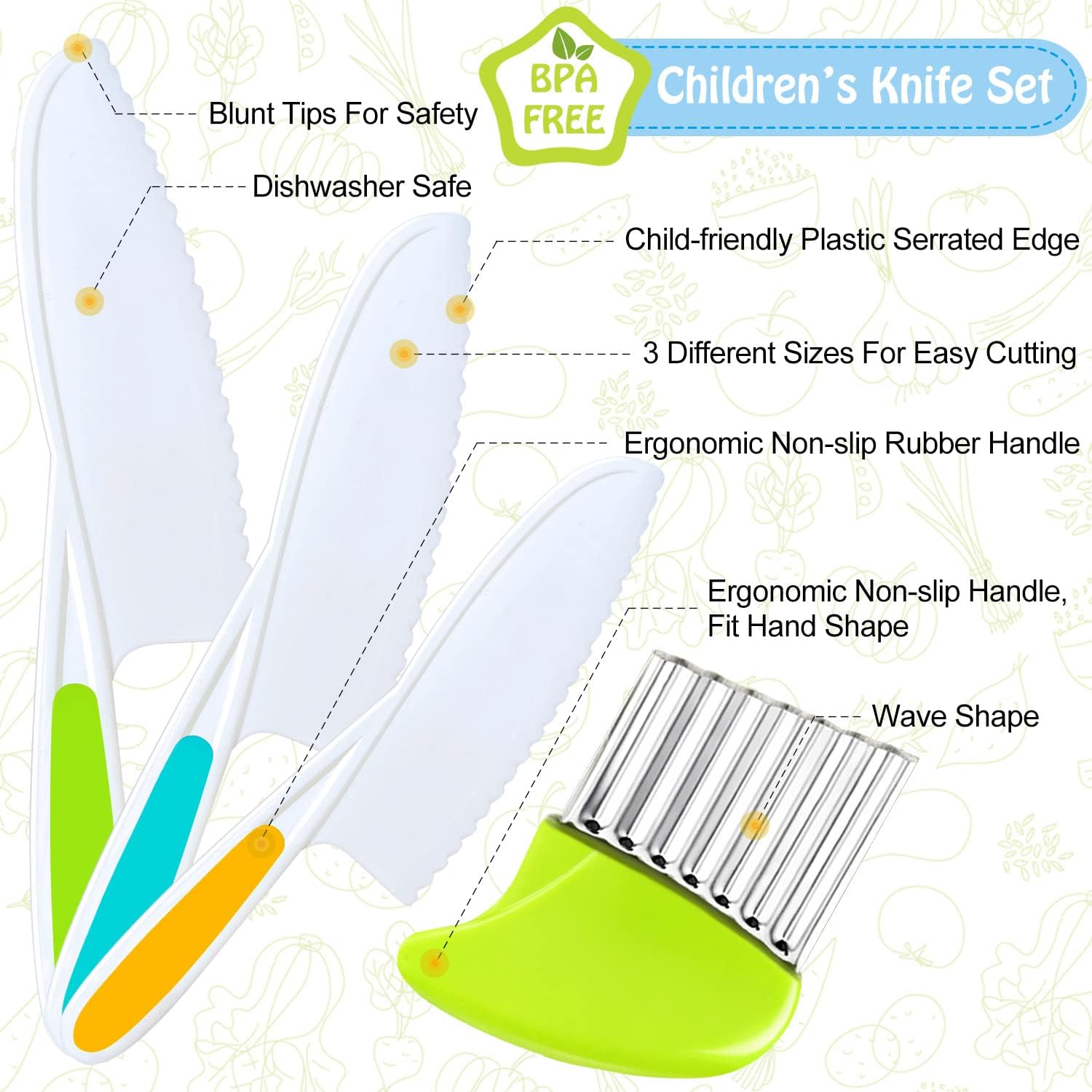
If your toddler has started pulling a chair up to the counter and reaching for whatever you’re using to chop dinner, you’re probably equal parts charmed and terrified. That instinct to participate is exactly what Montessori educators have built an entire kitchen philosophy around. “Montessori” (named after Italian physician Maria Montessori) is an educational approach that emphasizes letting children do real, meaningful work — including real cooking — with appropriately scaled, genuinely functional tools. A Montessori toddler knife isn’t a toy; it’s a child-sized cutting tool with a dull-but-effective serrated or wavy edge designed so a two- or three-year-old can actually cut a banana without cutting themselves. This guide will walk you through exactly what to look for, what to skip, and which choices make sense at which ages — no guesswork required.
What “Montessori-Safe” Actually Means for a Toddler Knife
Here’s the confusion most parents hit early: “Montessori” on a product label is not a regulated certification. Any brand can print it on packaging. What actually matters is the combination of blade design, handle ergonomics, and material quality — and understanding those three things will protect you from buying something that looks good in an unboxing video but frustrates your kid in the kitchen.
Blade design is everything. The knife category that works for toddlers (roughly ages 2–5) is a serrated or wavy-edge nylon or stainless blade with a tip that’s blunt or rounded. The serration does the cutting work — it grabs soft foods like bananas, strawberries, and cooked vegetables — without requiring the downward pressure that makes a slip dangerous. Parents.com notes in their coverage of kids’ kitchen readiness that toddlers lack the hand strength and wrist stability for smooth-edge blades, making the wavy-edge serrated design the developmental sweet spot for the under-five crowd.
Handle fit matters more than parents expect. A handle sized for an adult hand forces a toddler into an awkward grip, which is actually less safe than a correctly sized one. Look for handles between roughly 3–4 inches long with a wide, non-slip grip — many are rubberized or made from soft-touch plastic. The Spruce Eats’ roundup of kids’ knives repeatedly flags handle circumference as the variable that separates “kids use this happily” from “kids abandon it after one session.”
Material and dishwasher safety. Nylon-blade options (like the classic Kuhn Rikon Kids’ Knife line) are the most forgiving — essentially impossible to nick a finger on, dishwasher-safe, and inexpensive enough to replace when lost. Stainless-steel options with a deliberately dulled serrated edge (common in sets like the Opinel Le Petit Chef series) step up for ages 6 and older when a child needs a blade that can actually handle denser produce. More on that age progression below.
The Age-and-Skill Ladder: Matching the Knife to the Child
This is where most buying guides skip the nuance you actually need. Toddler knife readiness isn’t purely about age — it’s about a combination of fine motor control, ability to follow a two-step instruction, and attention span. That said, here’s a practical framework that holds up across the developmental research cited by both the American Montessori Society and the American Academy of Pediatrics:
Ages 2–3 (Earliest Starters) Soft foods only: banana, strawberry, cooked carrot, avocado. A nylon wavy-edge knife is the right call here. The goal isn’t culinary output — it’s the ritual of participation, the vocabulary of “knife hand stays on the handle,” and the satisfaction of doing something real. Reviewers across aggregated listings for nylon kids’ knives consistently note that this age group responds most to bright colors and lightweight feel.
Ages 3–5 (Building Confidence) Still a serrated or wavy-edge blade, but your child can now handle slightly firmer produce — cucumber slices, halved grapes (for salads, not a choking-risk context), soft cheese. At this stage, a set that includes a small cutting board sized for a toddler’s workspace becomes genuinely useful. Many families find a bundled knife-and-board set worth the modest premium over buying separately because the proportions are designed to work together.
Ages 5–7 (Transition Zone) This is where a step-up stainless option starts making sense for kids who have demonstrated consistent grip discipline and can reliably keep fingers curled in the “claw grip” that protects fingertips. Good Housekeeping’s review of kids’ knives places this transition squarely at age six for most children, though they note that some confident five-year-olds are ready and some seven-year-olds aren’t — and that’s completely normal.
Ages 8+ (Junior Chef Territory) This is the audience for a real knife like the Opinel Le Petit Chef set, which includes a genuine stainless blade, a peeler, and a finger guard. At this level, you’re no longer in toddler-knife territory — you’re in the junior chef gear conversation, which is a separate buying decision.
By the Numbers
| Age Range | Recommended Blade Type | Target Foods | Avg. Price Range |
|---|---|---|---|
| 2–3 years | Nylon wavy-edge | Banana, strawberry, soft cooked veg | $8–$18 |
| 3–5 years | Nylon or dull stainless serrated | Cucumber, soft cheese, avocado | $15–$30 |
| 5–7 years | Dull stainless serrated | Firmer produce, bread | $25–$50 |
| 8+ years | Real stainless (supervised) | Full range | $45–$80+ |
What to Look For — and What to Skip
Look for:
-
ASTM F963 compliance. ASTM International’s F963 Consumer Safety Specification for Toy Safety (2024 revision) covers children’s kitchen tools marketed for young children. Products meeting this standard have passed independent lab evaluation for sharp edge limits, small parts, and material safety. It’s not a guarantee of quality, but it’s a meaningful floor. Check the product listing or packaging for explicit F963 mention.
-
A non-slip base on any included cutting board. A board that slides when a toddler presses down on it is a safety hazard regardless of how safe the knife itself is. Suction-cup bases or rubberized undersides are worth prioritizing.
-
Sets with a finger guard. Some toddler sets include a small plastic finger guard — a C-shaped piece that sits between the knife hand and the blade. Owners consistently report these feel awkward at first but become intuitive quickly, especially for children on the younger end of the range.
-
Lightweight total weight. Under 2 ounces for a toddler blade is the target. A heavy knife causes wrist fatigue and increases the chance of a loss-of-control slip. Published specs for nylon kids’ knives typically land well under this threshold.
Skip:
-
Any knife marketed as “Montessori” with no blade or material specifications listed. Vague listings from unfamiliar brands with no ASTM mention and no material disclosure are a red flag. The Montessori label alone is decorative.
-
Full-tang stainless blades under age 6. Full-tang means the steel runs the full length of the handle — it’s a quality marker for adult knives but irrelevant (and unnecessary) for toddlers.
-
Sets that include multiple knives when one will do. A three-knife toddler set sounds like a value; in practice, toddlers use one knife, and storing three small sharp-ish items is a management headache. Start with one good knife and a board.
The Decision Frame: Which Purchase Actually Makes Sense Right Now
If you’re staring at a product page trying to make a call, here’s the clearest version of the decision tree:
If your child is under 3 and you want to start kitchen participation now: Buy a single nylon wavy-edge knife in the $10–$18 range. Don’t overthink it. The developmental value is in the ritual, not the tool sophistication. You’ll likely step up within 18 months anyway.
If your child is 3–5 and has already been doing some kitchen participation: A bundled knife-and-board set in the $20–$35 range is the right move. Look for one with a non-slip board, a dishwasher-safe knife, and an explicit ASTM F963 citation. Here’s what other families have consistently found useful: sets where the board is sized to sit inside a standard sheet pan, making cleanup a one-tray operation.
If your child is 5–7 and you’re considering stepping up: Pause before buying a junior chef set at $60–$80. The Spruce Eats’ review guidance consistently suggests that the transition to a stainless step-up knife should follow demonstrated claw-grip consistency — not just age. A three-month checkpoint (“can my kid independently use the claw grip every time, without prompting?”) is a more reliable trigger than a birthday.
If you’re buying as a gift: A nylon toddler set in the $15–$25 range with a small board and a simple wipe-clean apron is a reliably well-received bundle for ages 2–5. It photographs well, it’s genuinely useful, and it signals intention without requiring the gift-giver to know the child’s exact skill level. For older kids (6+), the Opinel Le Petit Chef set is the gift that consistently earns the “this is a real thing” reaction from parents — but confirm the child has kitchen experience first.
A Note on Supervision and the Long Game
No knife set — nylon, stainless, or anything in between — replaces adult presence in the kitchen with a toddler. The American Academy of Pediatrics’ kitchen safety guidance is clear: children under 5 should always have direct adult supervision during any cutting activity, and children 5–10 should have a supervising adult in the room. The Montessori philosophy isn’t “hand them a knife and walk away” — it’s “give them a real tool and stand close enough to guide the grip.”
The payoff, according to the American Montessori Society’s Practical Life documentation, is measurable: children who participate in real food preparation develop stronger fine motor skills, greater food acceptance (yes, including vegetables), and a sense of competence that carries well beyond the kitchen. The knife is the entry point. The confidence is the real investment.
Start simple, stay close, and let your kid make the salad.