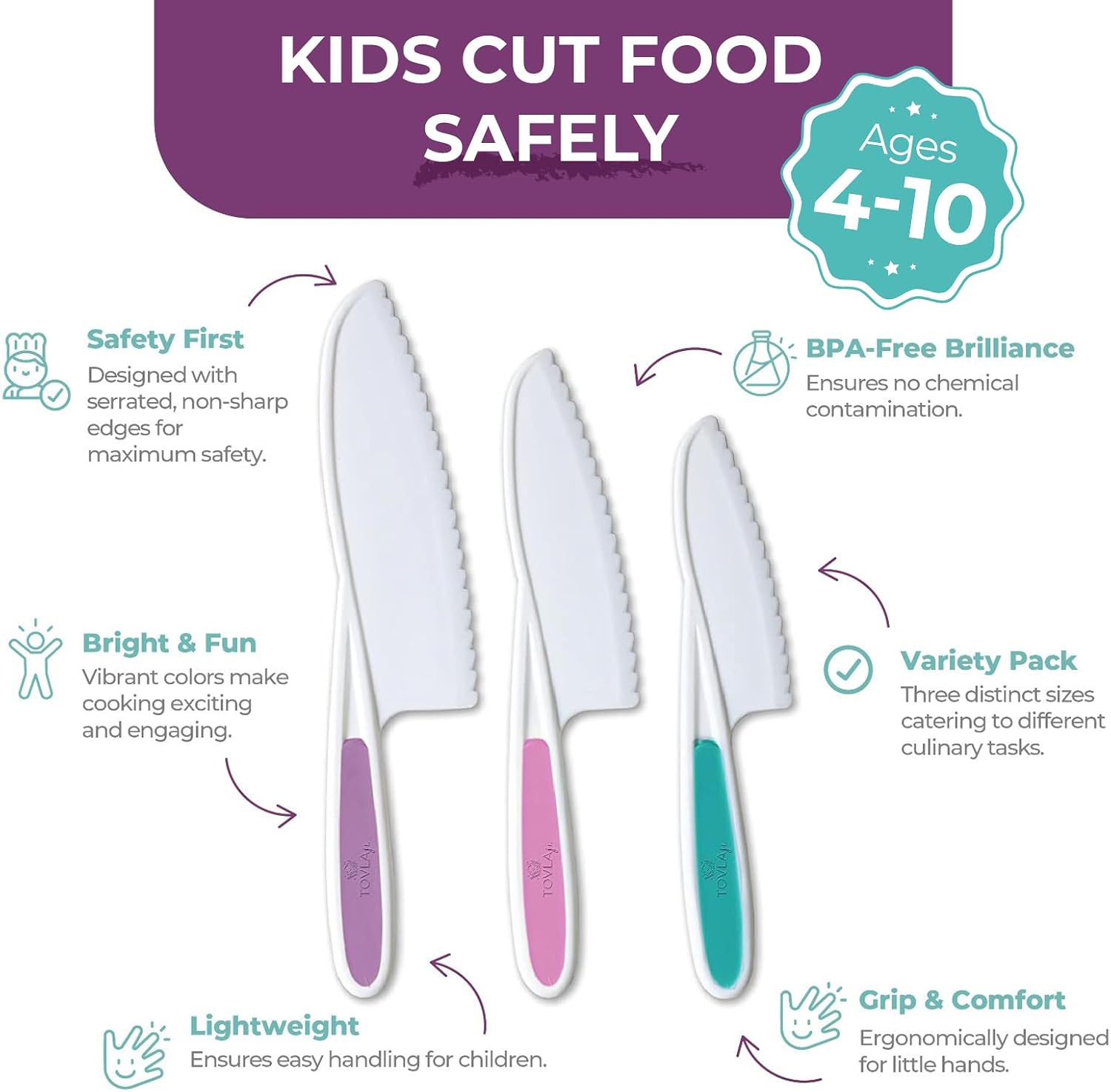
If the first image that comes to mind when someone says “kids’ knife” is a flimsy plastic thing that barely scores a banana — you’re not alone. For a long time, that was the whole market. But children’s knife design has genuinely grown up, and so has our understanding of when kids are developmentally ready to move from toy tools to real ones. A “real knife,” for the purposes of this guide, simply means a blade designed to actually cut food — safely, age-appropriately, and with adult supervision — rather than a toy prop. Getting this transition right matters more than most parents expect: the skills kids build in the kitchen at 5, 8, and 12 years old compound over time into genuine culinary confidence. This guide will walk you through the age-by-age markers of readiness, name the tradeoffs between popular knife options at each stage, and give you a clear decision rule so you don’t leave a gift card sitting unused because you weren’t sure what to buy.
What “Ready” Actually Means (It’s Not Just About Age)
Age ranges are a useful starting point, but every child’s readiness is its own calculation. The American Academy of Pediatrics’ kitchen safety guidance makes a helpful distinction: chronological age is a proxy, not a guarantee. The factors that actually predict safe knife use in young children are fine motor control (can they hold a pencil steadily?), the ability to follow multi-step instructions without losing focus, and an understanding of cause-and-effect — specifically, that a blade moving toward fingers causes injury.
A few concrete readiness markers to assess before you buy anything:
- Focus duration: Can your child complete a 10-minute task — a puzzle, a craft — without significant prompting?
- Grip strength and stability: Can they press and hold a fork through a piece of cooked chicken without the utensil slipping?
- Impulse control: When they’re excited, do they stay at the counter, or do they spin around with whatever’s in their hand?
- Frustration response: When something doesn’t work on the first try, do they stop and ask for help, or does the tool become a projectile?
None of these are pass/fail absolutes. They’re the variables in your decision, and you know your child better than any age chart does. That said, here’s how the age ranges map out in practice.
Age-by-Age Breakdown: The Right Tool for Each Stage
Ages 3–5: Crinkle Cutters and Lettuce Knives
At this stage, the goal is building the idea of cutting — the pinch grip, the downward pressure, the “eyes on the blade” habit — without any meaningful injury risk. The tools for this stage aren’t really knives at all.
Crinkle cutters (the wavy-edged plastic or stainless tools often seen in Montessori kitchens) work beautifully on soft foods: bananas, strawberries, steamed carrots. The Curious Chef brand, frequently cited in Spruce Eats roundups of beginner kids’ kitchen tools, makes a set that parents consistently describe as genuinely functional for 4-year-olds — not a toy, but not intimidating.
Lettuce knives — wide, serrated nylon blades — are the other staple at this stage. They won’t cut skin, but they’ll tear through a head of romaine or a cooked mushroom. Good Housekeeping’s kids’ knife roundup notes that nylon lettuce knives remain a reliable first-step tool precisely because the failure mode (dragging instead of cutting) is instructive rather than dangerous.
The tradeoff here: Nylon tools teach the motion and the safety mindset, but they don’t cut like a real knife. Some kids plateau on them quickly and grow frustrated. If your 5-year-old is genuinely bored with a crinkle cutter after three months, that frustration is useful signal — it may mean they’re ready to graduate sooner than you expected.
Ages 5–7: Rounded-Tip Starter Knives
This is the first stage where “real” metal enters the picture. The defining feature of a good starter knife for this age group is a rounded or blunted tip — the point is where accidents happen when kids are startled or lose focus. A rounded tip doesn’t eliminate risk, but it meaningfully reduces the severity of any slip.
The Opinel Le Petit Chef knife (part of their dedicated children’s set, retailing around $60–$80 for the full set) is the benchmark product in this category and comes up repeatedly across parent reviews and culinary education circles. Opinel’s published guidance recommends their Le Petit Chef line starting at age 6 with supervision. The blade is real stainless steel — it actually cuts — but the tip is rounded and the blade geometry is forgiving for small hands. Families who’ve used it report that the handle size and weight are genuinely calibrated for children, not just a scaled-down adult knife.
What to look for in this tier:
- Blade length: 3–4 inches is ideal; longer blades are harder to control
- Handle material: Non-slip grip matters more than aesthetics — look for textured or rubberized handles
- Tip profile: Rounded or sheepsfoot (flat tip, no point) over a standard chef’s point
The tradeoff: Real metal knives at this stage require committed adult supervision. You are not buying independence — you’re buying a supervised learning tool. If you don’t have the bandwidth to stand at the counter while your 6-year-old practices, a crinkle cutter is still the right call for your household. Neither choice is wrong; they’re different investments of your time.
Ages 8–11: The Bridge to Real Technique
This is the stage where things get genuinely interesting. An 8-to-11-year-old with a year or two of kitchen experience is often ready for a proper small chef’s knife or paring knife — a blade that cuts, holds an edge, and rewards proper technique. This is also the stage where grip and hand position actually matter for outcomes, not just safety.
The America’s Test Kitchen Kids cookbook series (their “The Complete Cookbook for Young Chefs” is the flagship) dedicates significant early content to the “claw grip” — the technique where fingertips are curled under and knuckles guide the blade. At this stage, teaching the claw grip alongside the knife is more important than the specific brand you choose. That said, a knife that fits the hand makes the claw grip learnable; an adult-sized 8-inch chef’s knife makes it nearly impossible for a 9-year-old.
By the numbers:
| Age Range | Recommended Blade Length | Tip Style | Supervision Level |
|---|---|---|---|
| 3–5 | N/A (crinkle cutter) | N/A | Full (hands-on) |
| 5–7 | 3–3.5 inches | Rounded | Full (at counter) |
| 8–11 | 4–5 inches | Rounded or standard | Active (in room) |
| 12+ | 5–6 inches | Standard chef | Available (nearby) |
At this stage, a paring knife — a short, narrow blade used for peeling and detail work — is often a better learning tool than a mini chef’s knife. The Spruce Eats’ kitchen tools guides for young cooks consistently recommend starting with paring knives in the 8–10 age range because the shorter blade length keeps control intuitive. Parents of kids in this range report that the investment in a real, well-made small knife (expect to spend $20–$40 for a quality standalone paring knife, or $60–$80 for a set) pays off quickly in actual kitchen utility — kids in this age range can handle most prep tasks in family recipes.
The tradeoff: A quality knife at this stage is genuinely sharp and requires real respect. Some parents feel more comfortable staying with rounded-tip options through age 10; others find their 8-year-old is visibly more careful with a sharp blade because they understand the stakes. Both instincts are defensible — the research on motor development from the AAP suggests that by age 8–9, most children have the fine motor capacity for standard blades, but emotional regulation and focus are the more meaningful variables.
Ages 12 and Up: Real Tools, Real Stakes
A 12-to-14-year-old who has been cooking for a few years is, in most respects, ready for the same tools an adult beginner would use — just sized appropriately. This is the stage where a 5-to-6-inch chef’s knife makes sense, and where blade quality, balance, and edge retention start to matter for performance (not just safety).
Parents.com’s cooking-with-kids coverage notes that teens who cook regularly often resist “kids’ versions” of tools by this age — and they’re not wrong to. A well-made 5-inch chef’s knife from a reputable brand is a real kitchen knife; calling it a “kids’ knife” is mostly a marketing category at this point.
This is also the stage where knife care and maintenance become part of the education: hand-washing and drying (not the dishwasher), storing in a knife block or magnetic strip rather than a drawer, and understanding that a dull knife is actually more dangerous than a sharp one because it requires more force. Good Housekeeping’s kitchen safety guides reinforce this point consistently — dull blades slip; sharp blades cut where you aim them.
Gift note: For the gift-givers in this audience, a curated knife-and-apron set for a 12-to-14-year-old is one of the most giftable premium bundles in the kids’ kitchen space. Williams Sonoma Kids and Uncommon Goods both carry sets in the $80–$130 range that photograph beautifully and deliver genuine kitchen utility — the kind of gift that earns real use, not shelf space.
The Clear Decision Rule
Here’s the framework that makes this simpler:
- If your child is under 5: Start with a crinkle cutter. The goal is habit-building, not cutting. No metal yet.
- If your child is 5–7 and can follow two-step instructions consistently: A rounded-tip starter knife like the Opinel Le Petit Chef set is worth the investment. Budget $60–$80 for the full set; it will last years.
- If your child is 8–11 and has been cooking regularly: A quality paring knife or small chef’s knife ($20–$45) unlocks real prep work. Pair it with the America’s Test Kitchen Kids cookbook so the claw grip gets taught alongside the tool.
- If your child is 12 or older and is genuinely interested in cooking: Skip the “kids’ knife” category. A real 5-inch chef’s knife from a quality brand, paired with a knife block and a lesson in care, is the right call — and the right gift.
The single most common mistake families make in this space isn’t buying too early or too late — it’s buying the right knife at the right age and then not being present enough to teach with it. The tool is the easy part. The fifteen minutes at the counter is the investment that actually compounds.