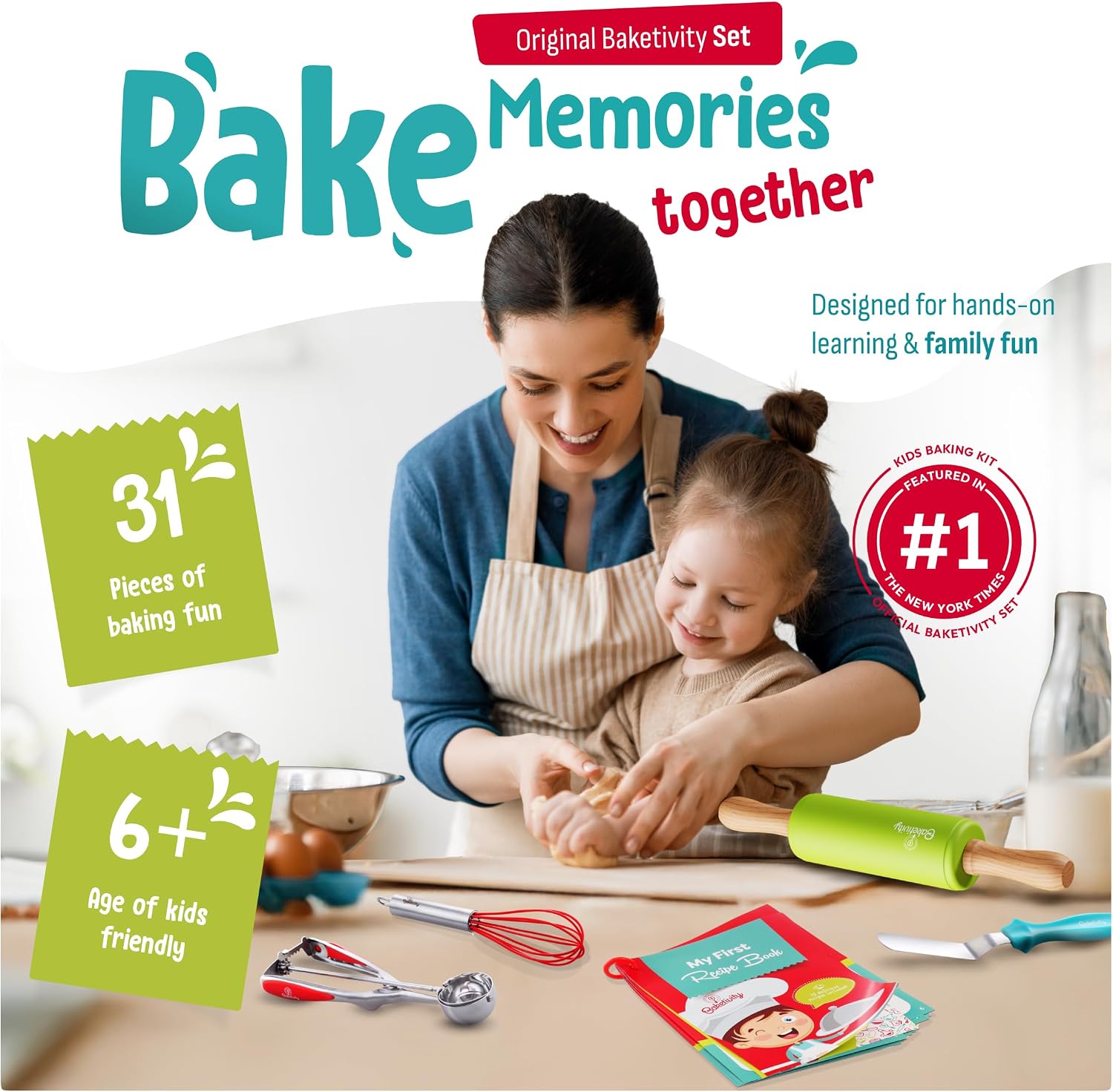
If your child has started asking to help in the kitchen — really help, not just lick the spoon — you’ve probably hit that exciting and slightly overwhelming moment where toy kitchens no longer cut it. Real baking with kids means using actual measuring cups, actual mixing bowls, and actual bakeware that goes in a real oven. A kids’ baking tool set is exactly what it sounds like: a curated collection of child-appropriate but genuinely functional kitchen tools, sized and weighted for smaller hands but built to produce real results. The difference between a good set and a frustrating one usually comes down to three things: durability, ergonomics (meaning whether a six-year-old can actually grip and control the tool), and whether the pieces survive repeated dishwasher cycles without warping or rusting. This guide is built around what families who bake together regularly actually keep using — and what tends to get shoved to the back of the drawer.
Why “Kid-Sized” Doesn’t Have to Mean “Toy-Quality”
Here’s the tradeoff that trips up a lot of parents on their first purchase: sets marketed as “kids’ baking kits” at the $15–$25 range often look adorable in the box but underperform in practice. Thin metal pans warp after two uses. Plastic spatulas melt near a warm pan. Measuring cups that aren’t calibrated accurately (yes, this is a real problem in cheap sets) teach kids the wrong ratios and then the cookies don’t rise and everyone is confused and slightly defeated.
The good news is that the mid-tier has gotten meaningfully better. In the $35–$60 range, you’re now getting tools that are sized for kids but manufactured to the same functional standards as adult tools — and that distinction matters enormously for a child who is genuinely trying to learn technique, not just play pretend.
The decision frame is simple: Are you buying this for imaginative play, or are you buying it because your kid wants to actually bake cookies from scratch? If it’s the latter, spend $10–$15 more than your instinct says and get the real thing.
By the Numbers
| Price Tier | What You Typically Get | Who It’s For |
|---|---|---|
| $15–$25 | Plastic tools, thin pans, decorative focus | Play kitchens, ages 3–5 |
| $30–$50 | Durable silicone + stainless, calibrated measures | First real bakers, ages 5–9 |
| $55–$85 | Full sets, premium bakeware, gifting-ready packaging | Committed junior chefs, ages 8–14 |
| $90–$150+ | Curated bundles with cookbook, apron, specialty tools | Gift market, milestone birthdays |
The Tools That Actually Do the Work
Before you evaluate any set, it helps to know which tools earn their spot in the drawer and which ones are filler. Based on what reviewers at The Spruce Eats consistently flag in their kids’ baking roundups, and echoed by the tool recommendations built into America’s Test Kitchen Kids’ The Complete Baking Book for Young Chefs, the genuinely useful pieces are:
Measuring cups and spoons (dry and liquid, separate sets). This is the non-negotiable foundation. A good kids’ set has clearly marked, dishwasher-safe dry measuring cups in standard sizes (¼, ⅓, ½, 1 cup) plus a separate liquid measuring cup with easy-to-read markings. Kids learn precision here first — don’t compromise on calibration accuracy.
A silicone spatula. Flexible enough to scrape a bowl clean, heat-resistant enough to fold batter near a warm pan. Good Housekeeping’s Institute testing of kitchen spatulas consistently points to silicone as the most durable and cleanest-releasing material for everyday baking tasks — and the same logic applies in miniature.
A bench scraper or bowl scraper. Underrated in starter sets, but owners consistently report it’s one of the first tools kids reach for once they learn to use it. It also doubles as a cleanup tool, which parents appreciate.
A half-sheet pan or quarter-sheet pan. Wirecutter’s bakeware coverage (New York Times Wirecutter, “The Best Baking Pans”) makes a compelling case for aluminum as the material that bakes most evenly — and Nordic Ware’s aluminum sheet pans are the recommendation that keeps appearing in that tier. A quarter-sheet pan sized for a smaller oven rack is the version most useful for kids who are baking alongside a parent.
A whisk. Small-handed whisks exist and they matter. A full-size balloon whisk is legitimately hard for a seven-year-old to control. Kid-sized versions (usually 8–10 inches) let children develop the wrist motion correctly.
What you don’t need in year one: a pastry brush (useful but not foundational), decorating turntables (fun but specialty), or cookie press kits (more frustrating than rewarding for beginners).
What Families Are Actually Buying (and Keeping)
Here’s where the research gets useful. Parents.com’s roundup of kitchen tools safe for kids highlights a consistent pattern: families who bake regularly end up supplementing starter sets with one or two quality standalone pieces, which means the best starter set is one that covers the basics well without locking you into an entire ecosystem of mediocre tools.
For the 5–8 age range: The sets that get the most repeated positive mention among parents who bake together weekly tend to center on silicone — mixing bowls that don’t slide on the counter, spatulas that don’t stain, and measuring cups that stack neatly. Tovolo’s baking line (available through Williams Sonoma and specialty kitchen retailers) regularly appears in this conversation. The color-coding in some of their sets helps kids who are still building reading skills identify the right measure quickly.
For the 8–12 age range: This is where the jump to real bakeware pays off. Nordic Ware’s quarter-sheet and half-sheet pans in natural aluminum have appeared in Wirecutter’s recommendations for years, and the pattern holds for kids using them — owners report even browning without hot spots, and the pans don’t warp even after extended use. A 10-year-old who has been baking for two years will feel the difference immediately.
For the gifting market ($75–$150 tier): The sets that photograph well and land well on unwrapping tend to bundle a tool kit with either an apron or a cookbook. America’s Test Kitchen Kids’ cookbook paired with a quality silicone tool set is a combination that shows up in holiday gift guides with regularity — and it works because the book is genuinely written for kids to use independently, with technique explanations that assume nothing. Phaidon’s children’s food books round out the premium gifting tier for families who want something beautiful on the shelf and functional on the counter.
The Safety Tradeoffs Nobody Talks About Enough
Parents.com’s guidance on kitchen tools for kids makes a point worth surfacing here: the safety conversation in kids’ baking tools has shifted. It’s no longer just about sharp edges and heat. It’s about material safety — specifically, whether silicone is food-grade (look for 100% food-grade silicone, not silicone-coated plastic), whether non-stick coatings on pans are PFAS-free, and whether plastic components are BPA-free at minimum.
The practical implication for buyers: always check the product description for explicit material callouts. Sets in the $15–$25 range rarely make these disclosures clearly. Sets at $40 and above from established brands (Nordic Ware, Tovolo, Williams Sonoma Kids) generally do. When in doubt, The Spruce Eats’ staff-reviewed roundups of kids’ baking sets consistently flag material safety as part of their evaluation criteria and are worth cross-referencing before you buy.
The dishwasher question is its own tradeoff. Most silicone is dishwasher-safe. Most aluminum bakeware is not — hand-wash only, or you’ll dull the surface and eventually get oxidation. If dishwasher-safe is a hard requirement (reasonable!), look for anodized aluminum or stainless steel pans rather than natural aluminum, understanding you’ll lose a small amount of even-browning performance in exchange for convenience.
The “If X, Then Y” Decision Rules
After mapping all of this out, here’s how to apply it to your actual situation:
If your child is 5–7 and this is their first time baking for real: Start with a silicone-forward set in the $35–$50 range. Prioritize a good spatula, calibrated measuring cups, and a kid-sized mixing bowl with a non-slip base. Don’t over-invest in bakeware yet — use your own pans and let the hand tools build their confidence first.
If your child is 8–11 and has been baking for a year or more: This is the right moment to invest in real bakeware. A Nordic Ware quarter-sheet pan and a quality silicone spatula upgrade will make a noticeable difference in results, which matters to a kid who is genuinely trying to improve. Budget $55–$75 for this combination and they’ll use it for years.
If you’re buying a gift for someone else’s child: Bundle a quality tool set with a cookbook. America’s Test Kitchen Kids is the safest, most universally praised choice for the cookbook component. For the tools, anything from a recognizable kitchen brand with clear food-grade silicone or aluminum labeling signals that you did your homework — which grandparents and aunts/uncles will appreciate as much as the parents will.
If dishwasher-safe is non-negotiable for your household: Skip natural aluminum pans and lean fully into silicone for bakeware (silicone muffin pans, silicone loaf pans) plus stainless measuring cups. You’ll trade some browning precision for real-world cleanup convenience, which is a completely reasonable trade for most families.
If your child is 12–14 and clearly serious about baking: They’ve outgrown the starter conversation. Look at what the adults in your life use — full-size Nordic Ware sheet pans, a quality digital kitchen scale, an Ateco offset spatula — and buy them that, in the same sizes. The “kid-sized” category has nothing more to teach them.
The through-line across all of this is simple: the tools that last are the ones kids can actually use effectively, in a kitchen where something edible comes out at the end. That outcome — a tray of cookies that actually worked, made by hands that measured and mixed and understood why — is worth spending a little more to get right the first time.