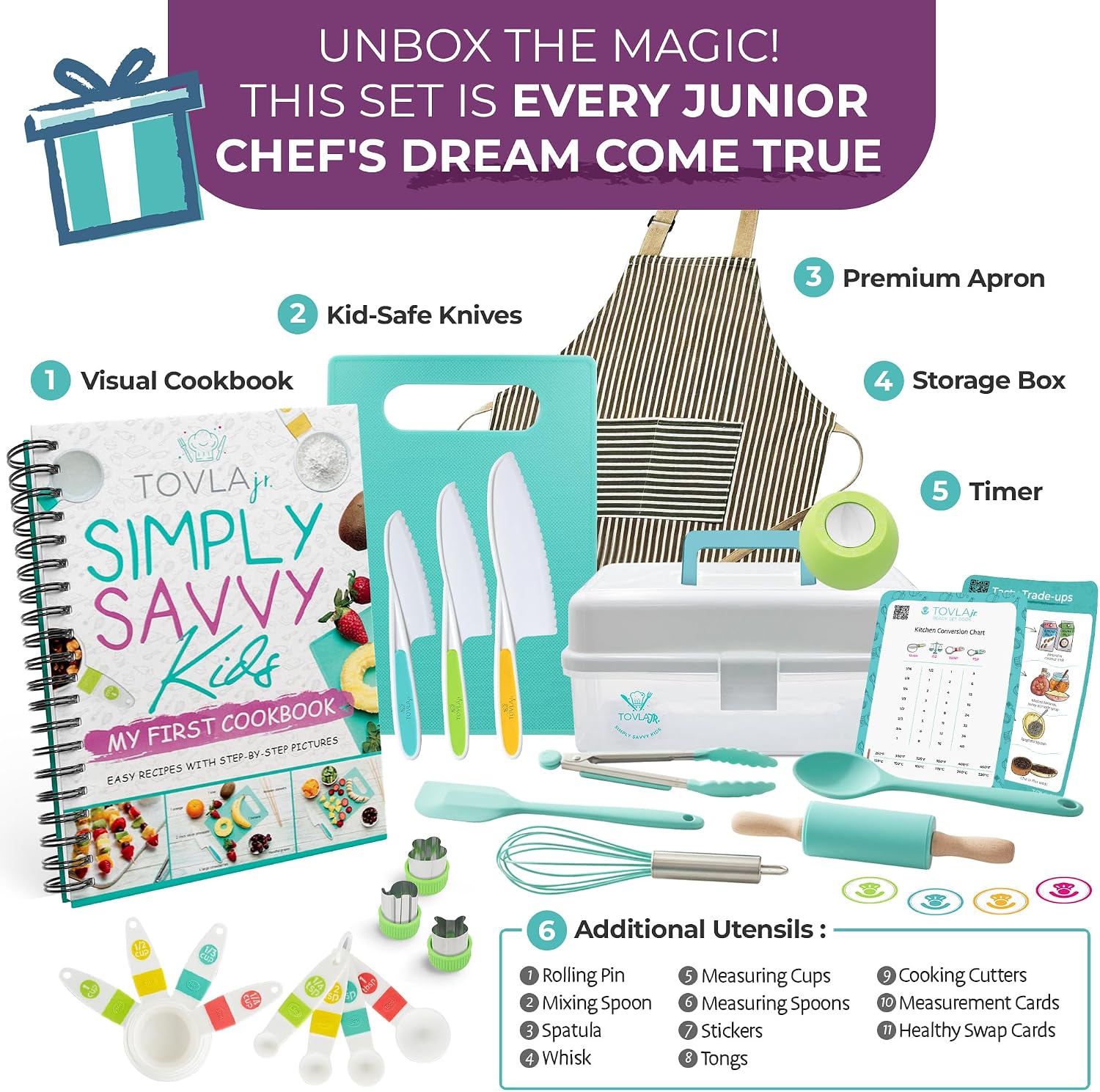
If you’ve ever stood in a kitchen store staring at a wall of gadgets, wondering what a 7-year-old actually needs to start cooking — you’re in exactly the right place. A “kids’ cooking gift” can mean anything from a $15 silicone spoon set (soft, flexible utensils designed so small hands don’t struggle with slippery metal) to a $75 curated knife-and-apron bundle with real, age-appropriate blades. The difference between a gift that gets used and one that ends up in a closet usually comes down to matching the gear to the child’s age, confidence level, and what they genuinely want to make. This guide walks you through the best options at every price point — $15, $30, $50, and $75 — so you can shop with a clear head and actually enjoy wrapping it.
One thing to know before we dive in: the children’s kitchen gear market has matured a lot in the past few years. What used to be mostly plastic toy kitchens has expanded into a genuine junior-chef category, with real brands — Opinel, Nordic Ware, Tovolo, Melissa & Doug, Phaidon — making thoughtful products for kids who want to cook, not just play at cooking. That shift is good news for gift-givers. It also means there are real tradeoffs to understand, and that’s exactly what we’re here to map out.
The $15–$25 Tier: First-Timer Starter Kits Worth Giving
This is the sweet spot for younger kids (roughly ages 4–7), gift-givers who aren’t sure yet how deep the interest runs, and anyone building a stocking-stuffer bundle. At this price, you’re mostly looking at silicone tool sets — spatulas, whisks, and measuring spoons made from food-safe silicone, which is a heat-resistant, flexible material that’s easier for small hands to grip and nearly impossible to break.
The tradeoff at this tier is longevity vs. immediate delight. A $15 silicone set is genuinely useful and dishwasher-safe (a huge win for parents), but it won’t grow with the child the way a $60 knife set will. Think of it as the right gift for a child whose interest is still being tested — low financial risk, high potential reward if cooking clicks.
What families keep coming back to: Reviewers at Good Housekeeping’s 2025 kids cooking roundup consistently call out silicone starter kits as the “gateway gift” — the thing that got a hesitant kid excited about actually cracking eggs and stirring batter. Look for sets that include at minimum a spatula, a whisk, and a set of measuring spoons, since those three tools cover probably 80% of beginner baking recipes.
One honest caveat: Very cheap sets (under $10) often have thin handles that crack after a few months of use. Spending the extra $5–$8 to hit a reputable brand typically buys you handles that stay intact through a full year of weekend baking.
The $30–$50 Tier: Bakeware Collections and First Cookbooks
This is where gifts start to feel intentional — the kind of thing a grandparent wraps beautifully and a kid actually remembers. At $30–$50, you’re entering the territory of branded bakeware collections (Nordic Ware and Tovolo are the names families cite most often in this range) and children’s cookbooks from publishers who take young chefs seriously.
By the numbers:
- Nordic Ware kids bakeware sets: typically $30–$45 for a 3–5 piece set
- Tovolo silicone bakeware bundles: typically $25–$40
- America’s Test Kitchen Kids cookbooks: $25–$35 per title
- Phaidon children’s cookbooks: $30–$45 per title
The decision between bakeware and a cookbook comes down to one question: does this child already have someone to cook with, or do they need the inspiration to get started? A cookbook is a better gift if the child’s adult co-pilot needs structured recipes to feel confident. A bakeware set is a better gift if they already love baking but are using mismatched adult pans that make everything harder.
The cookbook tradeoff: America’s Test Kitchen Kids (per the ATK Kids Cookbook Collection overview) is built around tested, reliable recipes that work — reviewers consistently describe it as “the cookbook that actually teaches technique, not just steps.” Phaidon’s children’s titles lean more beautiful and aspirational — stunning photography, global cuisines — but some recipes assume more adult supervision. If the child is 8–10 and cooking alongside a parent, either works beautifully. For a kid cooking more independently, ATK Kids has the edge on clarity.
The bakeware tradeoff: Nordic Ware is manufactured in the United States and owners consistently report it as genuinely durable — pieces that survive years of use rather than warping after a season. Tovolo’s silicone-forward approach is excellent for younger kids (nothing sharp, nothing that dents, fully dishwasher-safe) but may feel less “serious” to a tween who’s ready for real kitchen gear. Parents.com’s age-by-age kitchen safety guide notes that kids 8 and older generally do better with more structured, professional-feeling tools — it signals that their cooking is being taken seriously.
The $50–$75 Tier: Curated Bundles and Real Tools for Real Cooks
This is the tier where gifts cross from “fun” into “investment in a skill.” At $50–$75, you’re looking at knife sets designed specifically for children (the Opinel Le Petit Chef set is the name that appears most consistently in this category), deluxe bakeware collections, and curated bundles that combine a cookbook, an apron, and a quality tool or two into something that photographs beautifully and feels cohesive to open.
Who this tier is really for: Kids roughly 8–14 who have already demonstrated genuine interest — they’ve made pancakes on their own, they ask to help with dinner, they watch cooking content and talk about techniques. Wirecutter’s 2025 gift roundup specifically calls out this age window as the point where “toy-adjacent” gear starts to feel patronizing and real tools become both safer (because the child has developed coordination) and more motivating (because the gear communicates respect for their skill).
On the Opinel Le Petit Chef set: This is a French knife designed specifically for children, with a finger-guard ring (a protective collar around the blade that physically prevents small fingers from slipping onto the cutting edge) built into the handle. It’s not a toy — the blade is real and functional — but the design genuinely reduces the most common beginner knife injury. Reviewers across aggregated reviews describe it as “the knife that made my kid take cooking seriously” and “the gift that changed how we cook together.” The set typically runs $60–$80 depending on the retailer and configuration. At the $75 ceiling of this guide, you can usually find the core set with a cutting board included.
The safety note gift-givers sometimes miss: The Opinel set, and any real knife, requires a brief adult orientation before the child uses it. The Spruce Eats’ review of kids baking and cooking kits notes that the transition from toy to real tool goes smoothly when an adult spends even 10–15 minutes on grip and cutting-board technique the first time. If the gift-giver isn’t the parent, it’s worth including a note suggesting that conversation — it reframes the gift as the beginning of a skill, not just an object.
The bundle decision: If you’re spending $65–$75 and torn between a single premium item (one great knife) and a curated bundle (cookbook + apron + basic tools), the honest answer is: it depends on what the child already has. A kid who already cooks regularly is better served by one tool that upgrades their experience. A kid who’s just getting started is better served by the bundle — it removes every “but I don’t have the right thing” excuse and creates a complete starter kit in one gift.
How to Match the Gift to the Child (The Decision Grid)
If you’re still deciding, run through this simple frame:
If the child is 4–7 and just starting to show interest → Silicone starter kit at $15–$25, possibly paired with a simple cookbook. Low risk, high fun, and you’ll know within a season whether to invest further.
If the child is 7–10 and bakes regularly with an adult → Branded bakeware set ($30–$45) plus an ATK Kids cookbook ($25–$35). This combination gives them tools that feel real and recipes they can actually follow without frustration.
If the child is 10–14 and is genuinely passionate → The Opinel Le Petit Chef set or a comparable real-tool investment at $60–$75. This is the gift that communicates “we see how serious you are.” Pair it with a more advanced cookbook (Phaidon’s titles work well here) if budget allows.
If you’re a grandparent or family friend who doesn’t know the child’s current skill level → Default to the $30–$50 tier with a beautifully illustrated cookbook. It’s the safest bet: cookbooks are genuinely hard to get wrong if you choose a respected publisher, they don’t require knowing pan sizes or blade preferences, and they give the family something to do together.
A Note on Giftability (Because Unwrapping Matters)
Here’s something the gift guides don’t always say plainly: at the $50–$75 tier, presentation is part of the value. The Opinel Le Petit Chef set comes in packaging that feels like a gift. Phaidon cookbooks are genuinely beautiful objects. Nordic Ware’s higher-end sets often include gift-ready tins. These aren’t things you need to apologize for caring about — a gift that looks considered is more meaningful, especially for a child who’s being taken seriously as a young cook.
Good Housekeeping’s 2025 roundup makes this point explicitly, noting that gifts in the premium junior-chef category “photograph beautifully and hold up to the expectation created by the unboxing.” That matters when you’re investing $75 and want the moment to land.
The right gift at any budget is the one that meets a child where they actually are — curious, capable, and ready to make something real. Everything else is just matching the price tag to the ambition.